
Load monitoring with RPE and RIR for amateur teams
Two players lift the same weight. One says it was a stroll, the other says it barely moved. The kilos are identical; the effort is not. That is what RPE and RIR measure.
In an amateur club gym, almost everything gets written down in kilos and reps. That is the easy part to measure and it is useful, but it leaves one question out: how hard was it for that person? Four sets of five at 80 kilos can be a gentle session for someone who arrives rested and a brutal one for someone coming off exam week, a long trip or legs still heavy from the match.
Two widely used scales capture that subjective side. This guide explains what they are, how they differ, how to set up a log the team will actually fill in, and what Squadra does with the data. It works just as well with a spreadsheet.
What RPE is
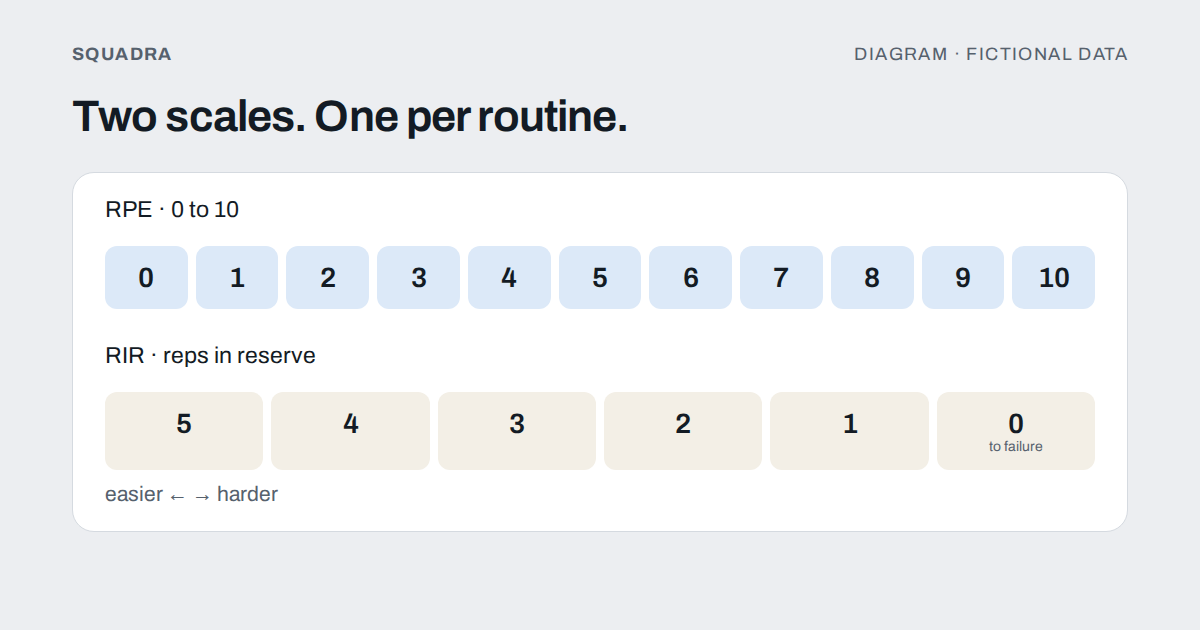
RPE stands for rating of perceived exertion. It is a number the person gives to how hard a set, an exercise or a whole session felt. The most common version runs from 0 to 10: near 0 is minimal effort and 10 is the maximum possible.
What matters is not the exact number but that it is their number. RPE does not measure anyone’s strength; it measures how the work is experienced. A higher RPE does not mean someone did better, and a lower one does not mean worse. It is a figure to read next to what you expected.
What RIR is
RIR stands for reps in reserve: how many more repetitions the person could have done when the set ended. You will also see it written as RER. An RIR of 0 means the set went to failure; a 3 means three more reps were left in the tank.
Unlike RPE, RIR goes down as the set gets harder. It is a short scale, from 0 to 5 (where 5 means «five or more») in whole numbers, which is what people can actually answer. «How many did you have left?» is a more concrete question than «how hard was that from 0 to 10?».
RPE or RIR: which to pick
There is no single answer, but you do not want to mix them without noticing:
- RPE fits when the group is already used to scoring effort, or when you rate a whole session rather than one set.
- RIR tends to work better with players who are just starting: «I had two left» is easier to say than choosing between a 7 and an 8.
- One scale per routine. If one set is logged in RPE and the next in RIR, no average you compute afterwards will mean anything.
Squadra follows that last rule to the letter: each routine picks one of the two scales, and every set is stored with the scale it was logged in.
How to set up a log people fill in
Most effort logs die of the same illness: they are paperwork nobody sees the point of. Four things help.
- Explain the scale once, with an example, and leave it written down. «A 10 is the most you could do today; a 2 is a warm-up». Two minutes in a pre-season talk beat a PDF.
- Log it on the spot. Six hours later nobody remembers how the third set felt.
- Decide when it gets logged. Per set if you want to refine one exercise; per session if what matters is the week’s load. What does not work is asking for one and analysing the other.
- Keep warm-ups apart. Warm-up sets are not effective work, and if they enter the average they pull it down and make the session look easier than it was.
Session load: a simple calculation
A common way to summarise a whole session is to multiply the perceived effort by the minutes it lasted. At the same effort, a ninety-minute session weighs more than a thirty-minute one. Add up the days of the week and you get a rough order of magnitude of how much each person has carried.
Two precautions. First, the result is for comparing each person with themselves over the weeks, not one person with another, because everyone uses the scale their own way. Second, it is a clue, not a verdict: if something does not add up, the sensible move is to talk to the player, not to change the plan because of a number.
Squadra does not do that multiplication for you. It gives you the session duration and the perceived effort separately, which are the two figures you need.
What Squadra does with RPE and RIR
This is what the app does today, with no embellishment:
- Each routine picks its scale. The strength and conditioning coach or the head coach chooses RPE (0 to 10) or RIR (0, to failure, up to 5) when creating it. Existing routines start on RPE.
- The player logs effort on every set, next to weight and reps, while doing the routine in the app. The field asks the question in the words of the chosen scale.
- An exercise can carry a planned effort, and the app suggests it as the starting value when it fits inside the routine’s scale.
- When the session ends, a summary with elapsed time, sets logged, volume (kilos times reps for sets that have both figures) and planned versus perceived effort. The perceived average leaves out the warm-up, and the summary itself reminds you how to read it: in RPE, higher does not mean better; in RIR, a lower number is a harder set.
- Changing scale does not rewrite the past. If a routine already has logged sets and you change its scale, the app warns you: earlier sets keep the scale they were logged with and new ones use the chosen one. The planned effort of each exercise is not converted from one scale to the other, so it needs a second look.
- RPE and RIR are never averaged together. Comparisons keep sets apart by scale.
- Coaching staff can review progress for each athlete in their scope: the 1RM for each exercise, the latest sets, and a comparison of perceived effort against the reference that was in place when each set was logged.
What it does not do: it gives no load recommendations, it does not decide for anyone how much to train, and it does not replace the coach’s judgement. It gathers the figure so the conversation happens with numbers on the table.
Sensitive data: who sees what
How hard training is for a person is personal information, and once it is combined with injuries, sleep or pain it becomes health information. It deserves care from day one, with or without an app.
- Whoever has permission, within their scope. A player’s sets can be consulted by coaching staff with permission to manage routines for that person, not by any club member. A coach for one category has no reason to see the one next door.
- Each player sees their own, and teammates do not see each other’s.
- Minors come with a guardian. With minors, who consents to health data being processed and who may see it is part of the design, not an afterthought.
Load monitoring is completed by a wellness diary (sleep, fatigue, pain, stress, mood), which in Squadra is separate, has its own permission and is not visible to any teammate. If that side interests you, it is covered on the load tracking and injuries page.
An honest test of whether it works
Pick three players and look at the last four weeks: do most of their sets have effort logged? If the answer is «more or less», the problem is not the scale, it is the timing and how easy it is to log. Simplify before you add more fields.
And one last rule: if a figure will never change a decision, do not ask for it. A short log that gets filled in is worth more than a complete one abandoned in October.
This guide explains a logging method and does not replace the advice of a strength and conditioning or health professional. If there is pain, injury or doubt about a person’s load, talk to whoever looks after them.
If you run a team, you may also like how to organise a call-up without the WhatsApp chain or who sees what in a club app.